Lecture 01 · CCMUN2026 · GA3 · ~10 min
Homelessness: Concepts, Causes & Challenges
Advancing the Right to Development
Learning Objectives
- Understand the OHCHR definition of homelessness and its human rights framework
- Analyze the relationship between the Right to Housing and the Right to Development
- Identify structural, institutional and political challenges contributing to homelessness
- Examine the intersectional vulnerability of displaced populations
01 · Committee Context
Welcome to UNGA3
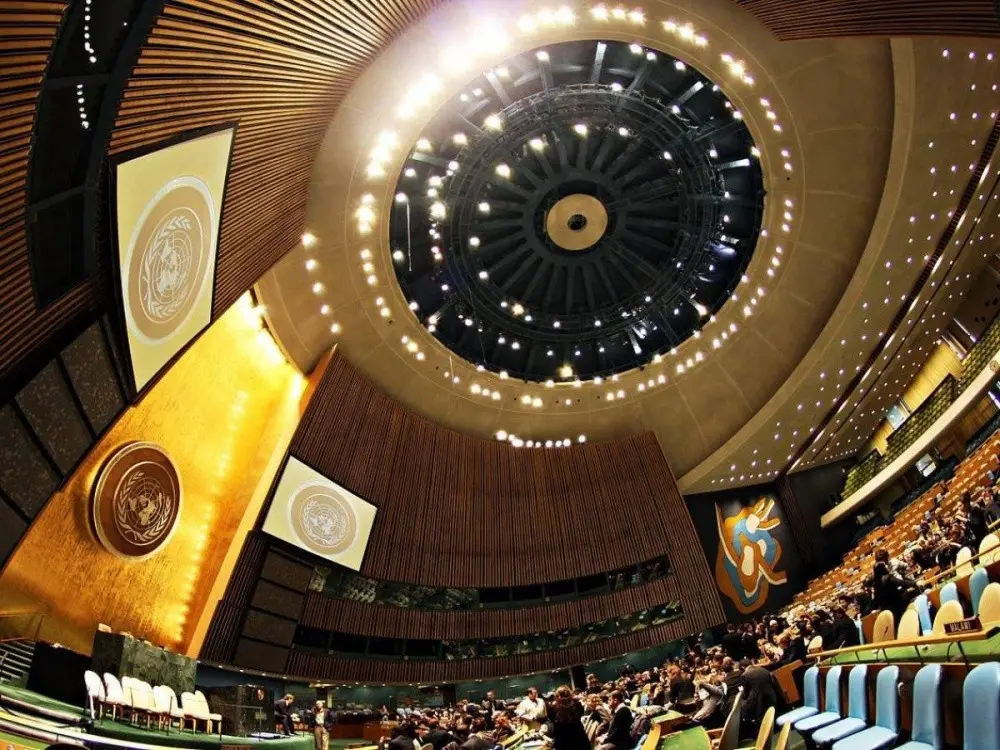
United Nations General Assembly Hall, New York (Photo: Basil D Soufi, CC BY-SA 3.0)
The Third Committee of the United Nations is responsible for human rights, social issues, and cultural affairs. During the 80th session of the General Assembly, the Secretariat submitted report A/80/316 and adopted document A/C.3/80/L.16 — a resolution addressing homelessness through the lens of the right to development.
"The Third Committee of the United Nations is responsible for human rights, social issues, and cultural affairs."
— UN Charter
Although the Third Committee's authority does not carry the same legal weight as that of the Security Council, its close ties with OHCHR and the UN Human Rights Council mean that the draft resolutions it adopts reflect a certain degree of consensus and serve to shape mainstream thinking.
At this year's session, draft resolutions on homelessness that were previously adopted without voting now face increasing division — revealing the growing politicization of human rights on the international stage.
03 · Legal Framework
Housing as a Human Right
The Right to Housing originates from the 1948 Universal Declaration of Human Rights, recognizing the right to an adequate standard of living. According to CESCR General Comment No. 4, this is the right to live somewhere in safety, peace, and dignity.
The Right to Development Dichotomy
Individual Dimension: Development should benefit people; the state respects individual choices and privacy. If development is an individual right, the nation’s development should serve its people.
Collective Dimension: The state is the fundamental guarantee for an individual’s place in the world. Individuals cannot survive or exist independently of the state.
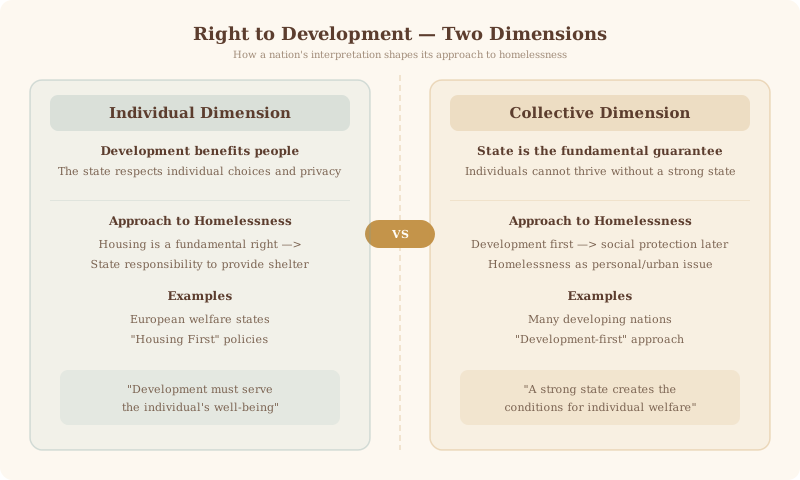
Two dimensions of the Right to Development: Individual vs Collective
Homelessness directly violates the rights to housing, health, and life. According to the OHCHR, states cannot use “insufficient stage of development” as a justification for delaying the resolution of homelessness — minimum core obligations must be fulfilled immediately.
04 · Global Crisis
Conflict, Climate & Housing Affordability
As of June 2025, 117 million people worldwide have been forcibly displaced by conflict and violence. The Russia-Ukraine conflict, the civil war in Sudan, and ongoing crises in Palestine and Iran have created unprecedented displacement.
The climate crisis not only directly causes displacement but also exacerbates conflicts. Over the past decade, weather-related disasters have caused approximately 250 million instances of internal displacement — about 70,000 per day.
1.6B
Severe housing unaffordability
1B+
Live in slums or substandard housing
By 2030, almost 3 billion people will require adequate housing. To meet this demand, about 100,000 units of affordable housing must be built globally every day.
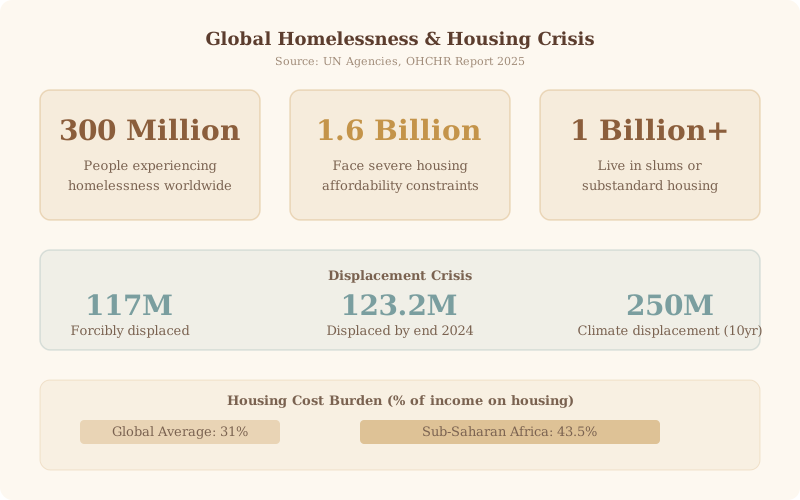
Global homelessness crisis in numbers (Source: UN Agencies, 2025)
"For every 10,000 housing units lost per 10,000 residents, the homelessness rate increases by 1 percentage point."
— Johns Hopkins University & UCLA Joint Study
05 · Intersectionality
The Most Vulnerable Among Us
Homelessness does not affect all populations equally. Three groups face particularly severe compounded vulnerability:
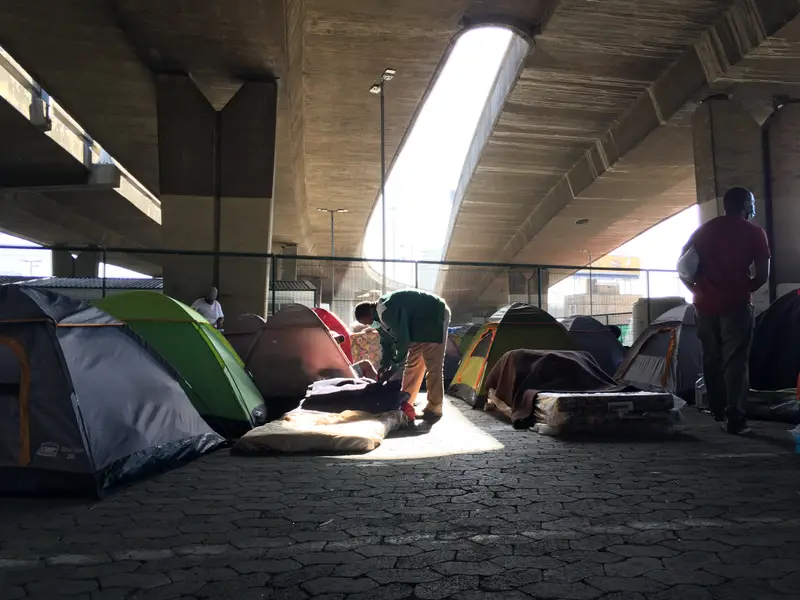
Homeless tents in Los Angeles Skid Row (Photo: Russ Allison Loar, CC BY-SA 4.0)
Women & Gender Minorities: Domestic violence is the leading cause of homelessness among women. One in four homeless women lost their housing due to partner violence. In 2024, women remain the group with the highest incidence of intimate partner violence.
People with Disabilities: Almost half of the homeless population has an intellectual or physical disability. People with disabilities are 2.5 times more likely to experience homelessness than the general population. Between 2018 and 2024, this group grew by 73% — the fastest-growing category among all homeless subgroups.
Migrants & Refugees: By end of 2024, an estimated 123.2 million people were forcibly displaced globally. Within the EU, foreign-born individuals face nearly twice the risk of poverty and social exclusion.
"Homelessness has become an embedded feature of asylum procedures in too many countries — even after being granted international protection status, beneficiaries still face a very high risk of homelessness."
— UN Human Rights Council Report, 2025
06 · Systemic Barriers
Fragmented Policies & Political Divides
The lack of a globally unified definition and reliable data remains the primary obstacle to ending homelessness. Each country has different approaches based on its stage of development, making consensus difficult.
Institutional weaknesses: Budget cuts, the rise of protectionism, and reduced international development aid undermine projects assisting the most vulnerable. Society appears unable to provide basic safety-net services following unemployment or personal crises. A systematic review of trauma interventions among homeless populations identified only one focused intervention from over 6,000 studies.
Political dimensions: The right to development itself has become a tool used on the international stage. Some nations believe human rights must be secured before the economy; others prioritize economic development first. These fundamental disagreements shape the international response to homelessness.
Choice implies sacrifice. How should delegates weigh their options based on their countries’ internal circumstances? That is the core challenge of this conference.