Lecture 02 · CCMUN2026 · GA3 · ~10 min
Regional Perspectives & Conference Outlook
Advancing the Right to Development
Learning Objectives
- Compare regional approaches to homelessness across Europe, Asia, Africa, and the Americas
- Analyze how the Right to Development shapes national housing policies
- Understand the international policy landscape and draft resolution dynamics
- Prepare for conference debates with informed positions
01 · European Approaches
Welfare State & Housing Rights
Europe generally adopts a rights-based approach to homelessness. Countries that prioritize individual rights believe that providing housing and resettlement for the homeless is the responsibility of the state and government.
European Trends
Many European countries have adopted “Housing First” policies that prioritize stable housing before addressing other issues like employment or substance abuse. The EU has frameworks for measuring and addressing homelessness across member states.
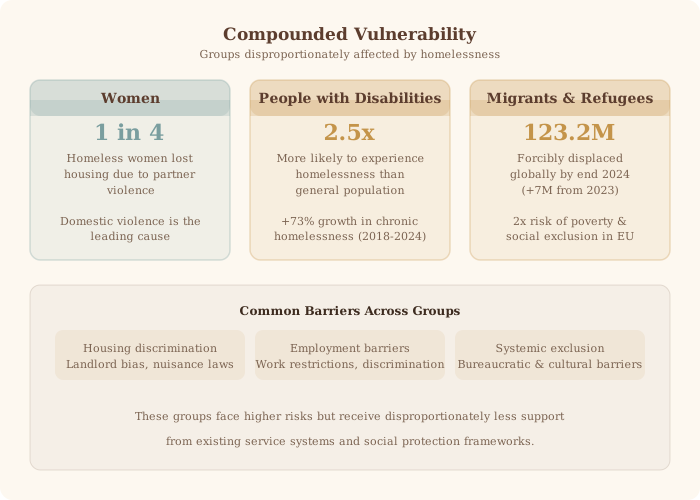
Groups disproportionately affected by homelessness worldwide
However, concerns remain. Reports indicate that the basic rights of migrants continue to be violated. Homelessness has become an embedded feature of asylum procedures in too many countries — even after being granted international protection status, beneficiaries still face a very high risk of homelessness.
Data from the OECD and EU show that within the EU, foreign-born individuals face nearly twice the risk of poverty and social exclusion compared to native-born individuals.
03 · The Global South
Informal Settlements & Urbanization
Latin America: Rapid urbanization has outpaced housing supply, leading to the continuous expansion of informal settlements and slums. Land ownership is virtually out of reach for most ordinary people, and severe inequalities in land distribution further exacerbate the housing affordability crisis.
Africa: Sub-Saharan Africa faces the most acute challenges. On average, households spend 43.5% of income on housing. The housing gap exceeds 51 million units.
28M
Nigeria’s housing deficit (units)
3.7M
South Africa’s affordable housing gap
38.8M
Internally displaced in Sub-Saharan Africa
Internal displacement in sub-Saharan Africa has reached a record high, accounting for approximately 46% of the global total.
04 · Climate & Displacement
Indigenous Housing & Climate Displacement
Oceania presents two distinct dimensions of homelessness:
Indigenous housing: In Australia and New Zealand, indigenous populations face disproportionately high rates of homelessness due to historical dispossession, systemic discrimination, and inadequate housing infrastructure in remote communities.
Pacific Island nations: For small island states, climate-induced displacement is an existential threat. Sea-level rise is already causing displacement, yet there remains a lack of international consensus on the legal status of displacement and homelessness caused by environmental factors.
"Climate change, conflict, and homelessness form a chain reaction — between 2020 and 2024, the number of homeless people in the United States increased by 33%, partly due to climate disaster property damage."
— Johns Hopkins University & UCLA Joint Study
05 · UN Framework
Global Policy & Draft Resolutions
The UN Human Rights Council produces a report on homeless populations almost every two years. At the 80th session, UNGA3 addressed this issue with report A/80/316 and draft resolution A/C.3/80/L.16 proposed by African nations.
Key challenges in the international community:
- No unified definition: The lack of a globally unified definition of homelessness and reliable data remains the primary obstacle.
- Fragmented funding: Budget cuts and the rise of protectionism have reduced international development aid.
- Politicization: Human rights have been increasingly weaponized in geopolitical maneuvering, becoming a tool for shaping public opinion.
- Vagrancy laws: In some regions, laws target and penalize those living outdoors, often exacerbating the problem without addressing root causes.
Although previous draft resolutions on this topic were adopted without voting, recent sessions have seen rifts emerging. This reflects the growing divide in how nations approach the right to housing and development.
06 · Conference Preparation
Guiding Questions for Debate
As you prepare for this conference, consider these critical questions:
Discussion Questions
1. How should nations balance the right to development with the immediate need to address homelessness?
2. Is homelessness primarily a personal failure or a systemic societal issue — and how does your answer shape policy?
3. How can the international community create a unified definition of homelessness that respects national differences?
4. What role should developed countries play in assisting developing nations with housing crises?
5. How do political ideologies — collectivism vs. individualism — shape a nation’s approach to housing rights?
Your choices as delegates will form the core of this conference. For choice implies sacrifice. How should you weigh options based on your country’s internal circumstances? Which is more important: the people or the state?